
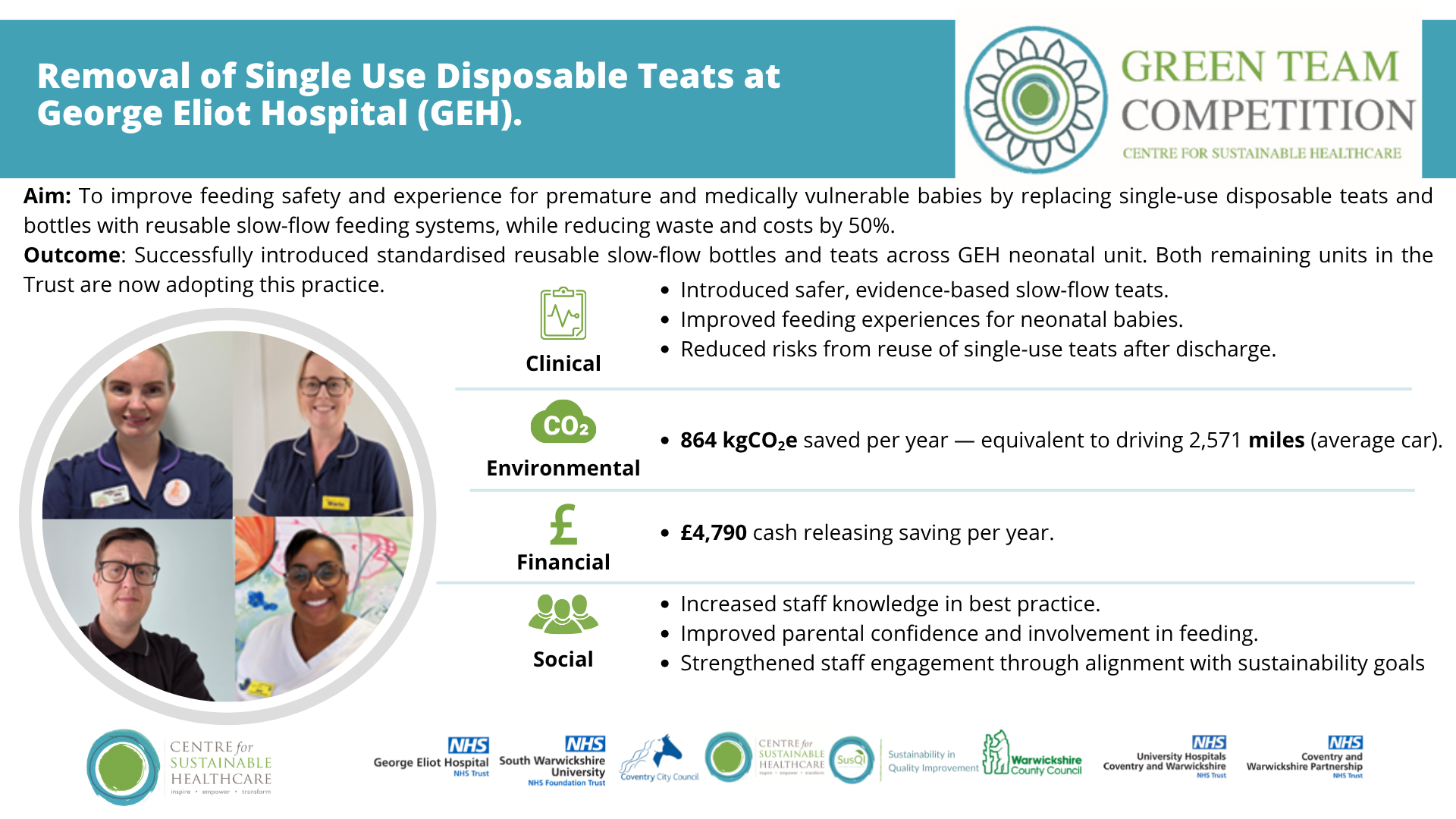
This project was completed as part of the Coventry and Warwickshire ICB Green Team Competition 2026.
Team members:
Sean Grant, Sustainability and Waste Manager
Maria Bull, Neonatal Matron
Amy Shuttleworth, Family Integrated Care Lead Nurse
Natalie Madden, Neonatal Speech and Language Therapist
Zoe Bush, Neonatal Speech and Language Therapist
Emily Robbins, Infant Feeding Support Worker
Setting / patent group:
Neonatal Unit at George Eliot Hospital NHS Trust, an 8-bed neonatal unit caring for approximately 300 babies each year.
Issue:
Many babies admitted to neonatal units require support transitioning from tube feeding to bottle feeding. Historically, the unit used single-use disposable bottles and teats; however, evidence suggests these teats often have faster and inconsistent flow rates, which can negatively affect feeding experiences, increase the risk of aspiration, and create challenges for premature or medically complex infants.
The team identified sustainability concerns associated with the use of large volumes of single-use plastic bottles and teats. Additionally, some families were taking disposable teats home and reusing them after discharge despite them not being designed for repeated use, creating potential safety risks.
Intervention:
The neonatal team replaced single-use disposable teats and bottles with evidence-based reusable slow-flow bottle systems, including MAM and Dr Brown's bottles and teats. Families were encouraged to bring their own bottles where possible, while reusable bottles were made available for those who were unable to do so.
The project included:
- Multidisciplinary collaboration between neonatal nursing, speech and language therapy, infant feeding and sustainability teams.
- Staff education through a virtual training package.
- Clear guidance on bottle and teat selection based on feeding needs.
- Use of existing sterilisation systems, avoiding the need for additional infrastructure.
- Parent engagement and co-production through local neonatal parent representatives.
Outcomes:
Clinical
The change standardised the feeding equipment available on the neonatal unit and ensured that bottle-fed babies were offered evidence-based slow-flow teats that support safer, developmentally appropriate feeding. Published evidence suggests slower-flow teats improve suck-swallow-breathe coordination, reduce feeding stress and lower aspiration risk. The project also eliminated the risk of families continuing to reuse disposable hospital teats at home and improved continuity between hospital and home bottle-feeding practices.
Environmental
Analysis based on 246 bottle-fed babies per year demonstrated that replacing disposable feeding systems with reusable bottles would reduce annual emissions from approximately 2,003 kgCO₂e to 1,139 kgCO₂e, producing a saving of 864 kgCO₂e annually, equivalent to a 43% reduction in carbon emissions. The project also significantly reduced single-use plastic waste by replacing multiple disposable bottles and teats with reusable alternatives supported through existing sterilisation processes.
Financial
Reusable feeding systems were considerably more cost-effective than disposable alternatives. Annual expenditure on disposable bottles and teats was estimated at £6,061, compared with £1,271 for reusable bottles, sterilisation bags and associated energy costs. This represents an estimated annual saving of £4,790, equating to a 79% reduction in feeding equipment costs.
Social
Staff reported increased confidence in supporting developmentally appropriate feeding and greater consistency in feeding practices across the multidisciplinary team. The project also strengthened alignment between staff values and the Trust's sustainability ambitions. Parents reported greater confidence in feeding their babies, improved understanding of feeding choices, and reassurance regarding both safety and environmental impact. Community teams also noted a reduction in families taking home and reusing disposable hospital teats after discharge.
Key learning point
Replacing disposable neonatal feeding equipment with reusable slow-flow bottle systems can improve feeding safety, support better developmental outcomes and reduce environmental impact without compromising care quality. Success relied on strong multidisciplinary collaboration, staff education, parental engagement and the use of existing sterilisation infrastructure. The project demonstrates how a simple change in routine practice can deliver meaningful clinical, environmental, financial and social benefits.
 Download resource -
Please log in or sign up to comment.