
Project completed as part of University Hospitals of Northamptonshire Green Team Competition.
Team members
Faye Ranger – Senior Staff Nurse, Critical Care
Laura Robinson – Advanced Pharmacist, Critical Care
Dr Charlotte Hall – Critical Care Registrar
Dr Matthew Beadle – Consultant in Critical Care
Agnes Oakley- Improvement and Excellence coach
Setting / patent group:
Adult critical care.
Issue:
Continuous sedation is essential for mechanically ventilated patients to facilitate tolerance. Prolonged uninterrupted sedation leads to drug accumulation, delayed awakening, longer ventilation duration, higher risk of ventilator associated pneumonia (VAP), and extended length of stay. There is strong evidence and national guidance recommending that sedation is stopped daily to prevent the buildup, this is known as a daily sedation interruption (DSI). Initiating DSI’s can improve outcomes and reduce complications. Following the COVID19 pandemic, Northampton General Hospital saw:
· Reduced frequency of DSIs
· Increased levels of oversedation
· Poor documentation of sedation holds
· Reduced staff confidence in performing DSIs
Critical care and pharmaceuticals have been identified as carbon hotspots within the NHS; they are both major contributors to NHS carbon emissions and have significant financial implications. The introduction of DSI’s within critical care has the potential to improve patient outcomes, reduce environmental and financial costs, whilst delivering social value.
Intervention:
The intervention focused on improving the consistency, safety, and documentation of daily sedation interruptions through several coordinated changes. Staff education formed a key component, with structured and opportunistic teaching sessions delivered to nursing and medical teams covering the evidence base, national guidance, contraindications, and correct restart procedures. Documentation processes were strengthened through updated bedspace guidance, including revised RASS, CPOT, neurological assessment and DSI procedure information. An interim DSI sticker was introduced to enhance visibility and recording on the existing 24-hour chart. Work also began on redesigning the full 24-hour chart to permanently embed prompts and documentation fields for sedation holds.
Outcomes:
Implementation of the DSI was not possible within the 10-week window; therefore, outcomes were modelled using evidence and baseline data. Once an appropriate cohort of staff have completed the training, the DSI stickers will be rolled out to be used alongside the 24-hour chart, until full integrated into the 24-hour chart.
Clinical outcomes:
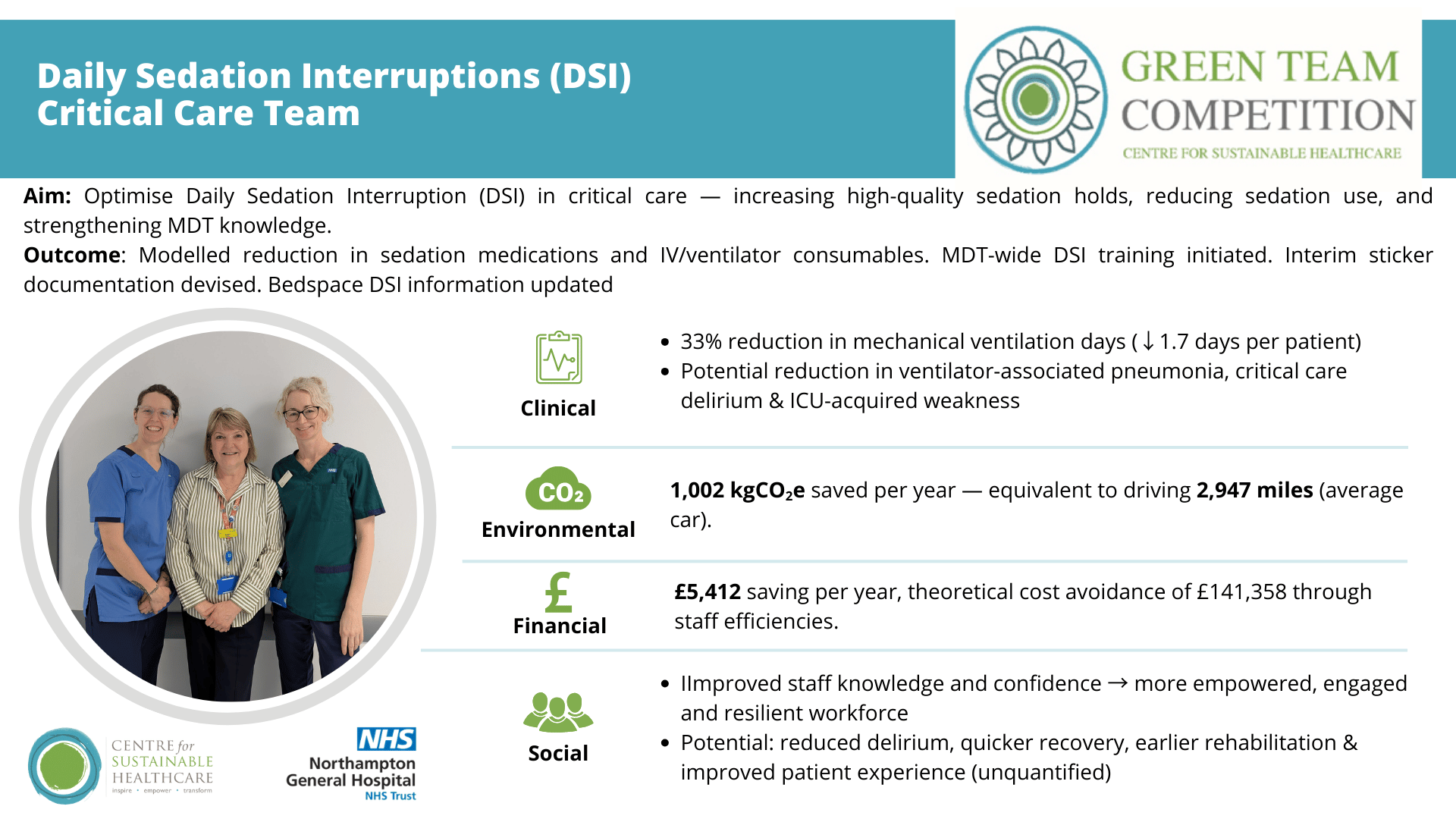
The modelled 33% reduction in mechanical ventilation, translates to a practical saving of 1.7 days in mechanical ventilation. The reduced duration of mechanical ventilation and exposure to sedation has the potential to reduce the risk of delirium, VAPs, critical care acquired weakness, post-intensive-care syndrome and prolonged ICU stay. The implementation of DSI’s, also Improves compliance with national GPICS guidance. The reduction in duration of mechanical ventilation has the potential to increase availability of critical care beds to the wider population and maximise efficient use of critical care resources.
Environmental savings:
Savings were modelled on a 25% reduction in propofol and alfentanil usage (and associated consumables) and a 33% reduction in ventilator consumable usage. There was a modelled saving of 3.56 kgCO₂e saved per patient episode and a 1001.6 kgCO₂e annual reduction across 281 ventilated patients. This is the Equivalent to driving 2,947 car miles in an average car of unknown fuel.
Financial outcomes:
The modelled 25% reduction in propofol, alfentanil and drug infusion consumables provides a saving of £11.25 per episode, equating to a yearly saving of £3162. The modelled 33% reduction in cost of ventilator consumables, delivers a £7,97 saving per episode of care, equating to £2239 per year. When combined, these results, (along with a small yearly saving from waste avoidance of £10.76) result in a yearly saving of £5,412.
The stepping down of patients from level 3 care (ventilated) to level 2 care (non-ventilated), has a potential yearly staff financial efficiency saving of £141,358. It is important to note that these figures do not translate into direct cost reductions within the Trust’s budget. In practice, nurses would be redeployed to care for other patients rather than no longer being required, meaning no cashable savings would be realised. Instead, the calculation reflects the relative efficiency gained when patients require a lower level of care, rather than a reduction in actual expenditure. The potential cost avoidance of just one VAP has the potential to save a further £10,000-£20,000. Bringing the combined annual modelled financial savings and cost avoidance to £146,770.07.
Patient and population outcomes:
Social impacts:
Staff confidence in performing DSIs improved from 81% to 97% following training. Staff had a higher perceived competence and clarity in sedation management, with increased knowledge and empowerment. There was a potential reduction in staff strain through improved workflow and fewer complications and enhanced team cohesion through shared training and consistent practice.
There were potential patient benefits from improved patient experience, reduced delirium, quicker recovery and earlier rehabilitation, but these could not be quantified within the project.
Patient feedback:
This could not be collected because sedation holds are not perceivable to patients.
Staff feedback:
Feedback from staff was evaluated via a word cloud, with phrases such as “I am confident”, “much better understanding” and “no concerns” being prominent.
Key learning point
Large‑scale practice change in critical care requires extensive training and governance time, beyond a 10‑week project window. When delays in implementation occurred, we were able to model predicted outcomes using established historical evidence. Staff education is essential and highly effective in improving confidence and multidisciplinary engagement was critical to the project success. Sedation practices carry significant environmental and financial impacts, highlighting the value of integrating sustainability into clinical decision‑making. Documentation changes must be fully integrated into existing charts to be sustainable.
Improved staff knowledge and confidence, leading to a more empowered, engaged & resilient workforce.
Potential for reduced delirium, quicker recovery, improved patient experience & earlier rehabilitation (not quantified during this project)
 Download resource -
Please log in or sign up to comment.