
Project completed as part of the University Hospitals of Northampton Green Team Competition.
Team members
Daniya Stany, IPC nurse NGH, Adwoa (AJ) Pokua-Manu, Audit and Surveillance Nurse, IPC NGH.
Setting / patent group:
Operating theatres and peri-operative areas.
Issue:
Operating theatres undergo frequent cleaning cycles, relying heavily on single use Clinell wipes and ChlorClean tablets. This created significant plastic waste, high carbon emissions, and recurring consumable costs. Chlorine products also carried risks including equipment corrosion, respiratory irritation, and reduced efficacy in the presence of organic matter. The project aimed to introduce DiffX, a sporicidal, pH neutral-neutral, biodegradable disinfectant, delivered via reusable bottles, reducing both environmental impact and reliance on disposables.
Intervention:
The Infection Prevention and Control (IPC) team led a phased rollout of DiffX solution in reusable spray bottles, replacing Clinell wipes and Chlor-Clean tablets in selected areas. A series of five PDSA cycles evaluated implementation, staff training, bottle labelling, preparation accuracy, and safety concerns. Staff feedback, observations, and Datix reports were reviewed, and training was strengthened where gaps were identified. Allergy concerns and bottle deformation were escalated appropriately, and Green Team Champions supported continued adoption
Outcomes:
Clinical
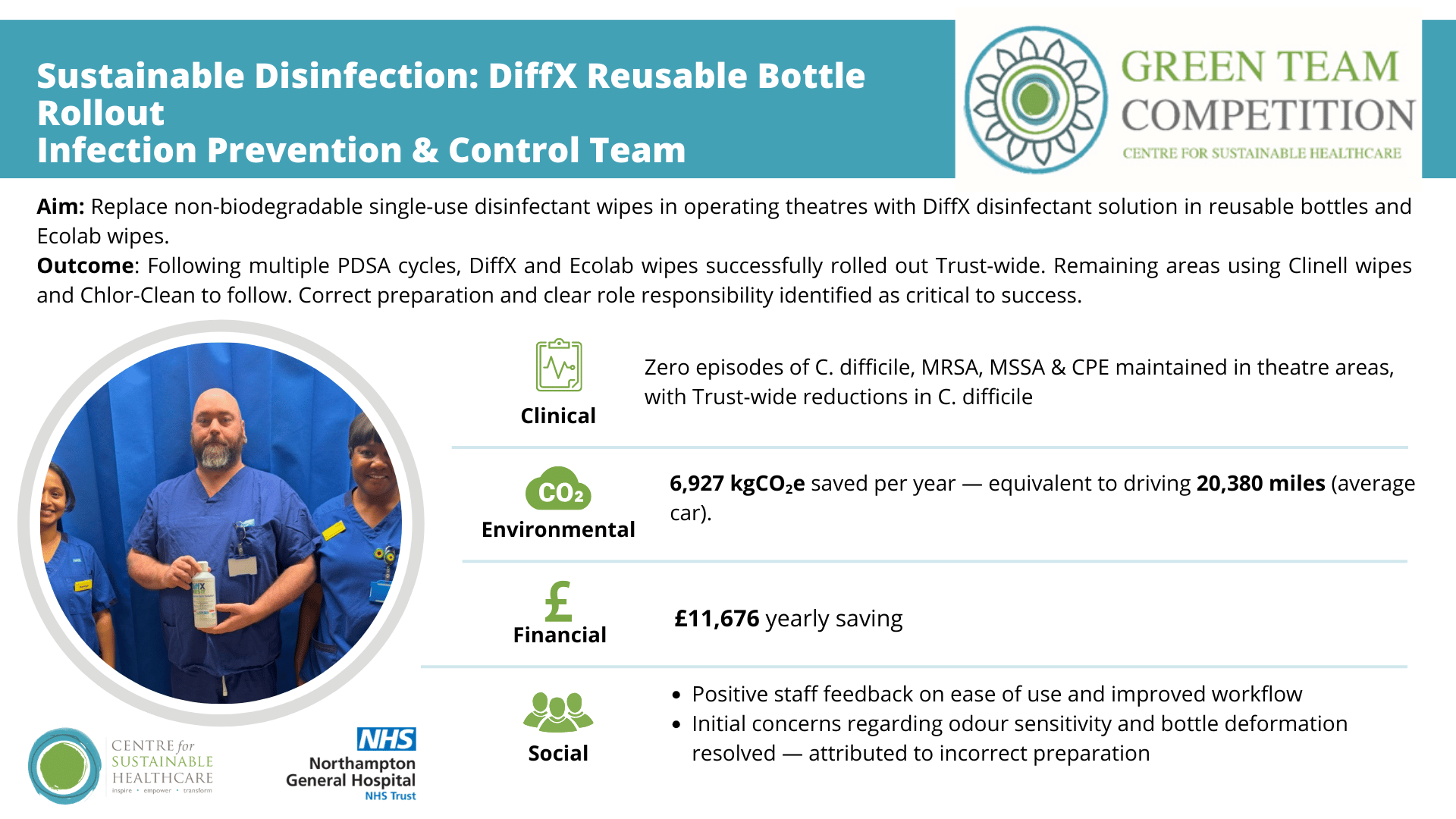
Throughout the year preceding the project and after implementation, no cases of C. difficile, MRSA, MSSA, or CPE were recorded in theatre environments. The introduction of DiffX did not compromise patient safety and maintained existing high infection prevention standards. As infections often manifest after patients leave theatre settings, measurable changes within theatres were limited, but trust wide reductions in C. difficile during 2025–2026 support the product’s wider effectiveness.
Environmental
Switching from nine Clinell wipes, one Chlor Clean tablet and a disposable bowl per clean, to four Ecolab wipes and DiffX in a reusable bottle resulted in a 67% reduction in carbon emissions. This equates to 20.8 kgCO₂e saved per day and 6927 kgCO₂e saved annually, equivalent to 20,380 miles driven in an average petrol car. The key driver of carbon reduction was the substantial reduction in wipe usage, not the biodegradability claims of alternative wipes.
Financial
Annual consumable costs dropped from £17,317 pre project to £5,641 post project, producing a yearly saving of £11,676. This reduction was driven by reduced wipe usage, removal of Chlor Clean tablets and pulp bowls, and the cost efficiency of DiffX sachets and reusable bottles. Additional potential cost avoidance arises from preventing infections, with treatment of hospital acquired C. difficile or MRSA bacteraemia costing up to £7,500 per case
Social
Staff reported that reusable spray bottles were practical, easy to use, and improved workflow by reducing the need to leave clinical areas to collect supplies. There was some negative feedback related to the strong odour of DiffX, though this improved with correct preparation methods. A small number of staff with known smell sensitivities or allergies experienced mild symptoms, resulting in appropriate risk assessments and adaptations such as PPE use or adjusted workflows. No confirmed allergic reactions to the product itself were identified.
Key learning point
Success relied on repeated education, strong IPC leadership, and close collaboration with theatre managers and Green Team Champions. The project emphasised the importance of early identification of staff sensitivities, clear allocation of preparation responsibilities, and avoiding assumptions about the environmental superiority of products labelled as “biodegradable.” The combination of behaviour change (reduced wipe use) and product substitution was crucial in achieving large carbon and cost savings.
 Download resource -
I'd not heard of this option before - it sounds like a good step, thank you for sharing! I will mention this when I meet with IPC team at my Trust to see if it can be considered here.
Please log in or sign up to comment.