
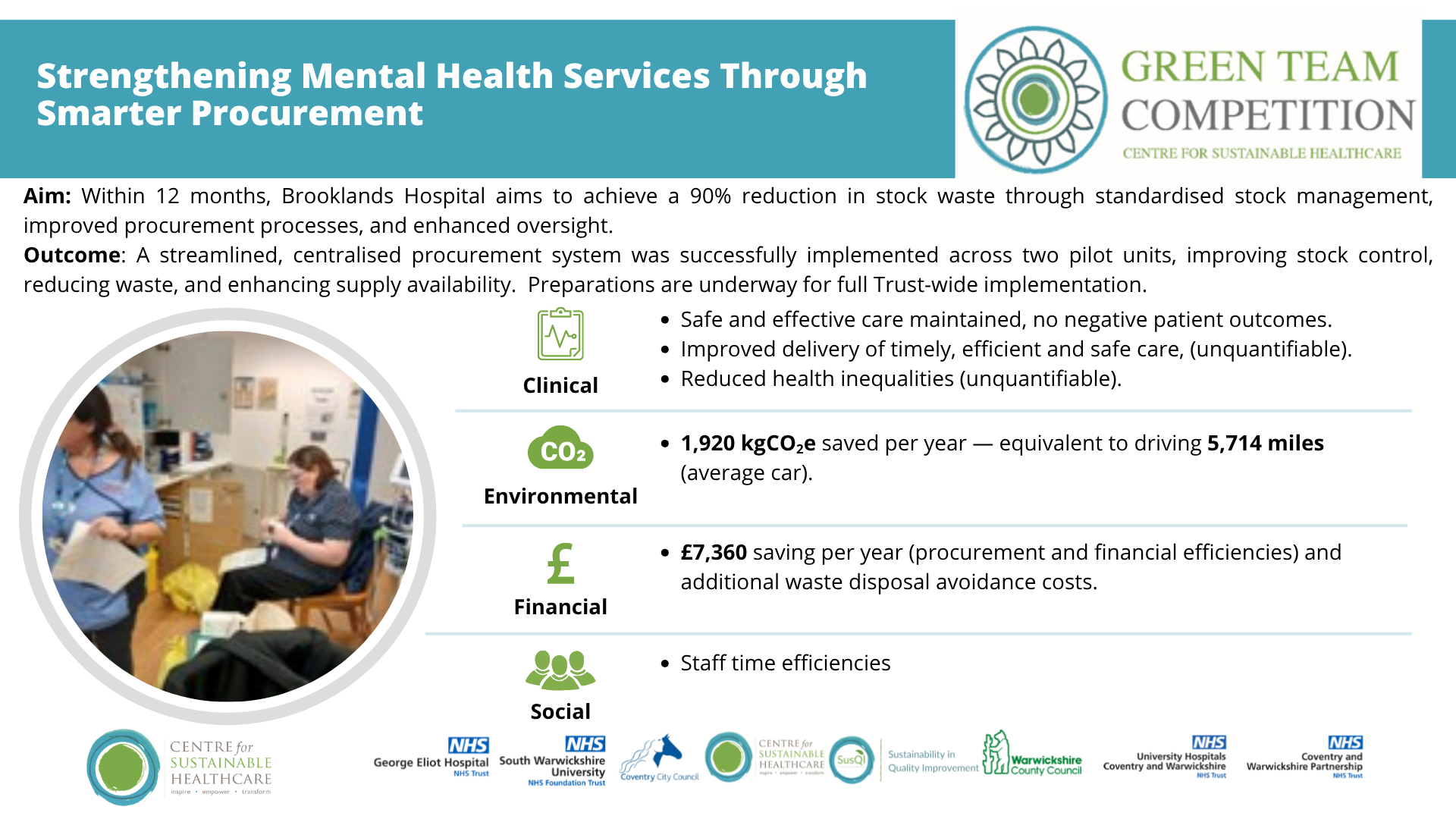
This project completed as part of the Coventry and Warwickshire ICB Green Team Competition.
Team members
This project was led by Claire Stickels, Trainee Advanced Clinical Practitioner at Brooklands Hospital, in partnership with Laura Smith, Lead Improvement Coach for Coventry and Warwickshire Partnership NHS Trust (CWPT). The project was supported by the Physical Health Team, nursing staff, administrative teams, and operational colleagues across Brooklands Hospital
Setting / patent group:
Brooklands Hospital, an inpatient Learning Disability and Autism hospital operated by Coventry and Warwickshire Partnership NHS Trust. The hospital provides a range of specialist services, including assessment and treatment, rehabilitation, adolescent, and forensic services for people with learning disabilities and autism.
Issue:
A review of clinical stock management identified considerable variation in the way wards ordered, stored, and managed clinical supplies. Essential items were sometimes unavailable when required, while other areas held excessive quantities of stock, including expired and duplicated products. Staff frequently spent time sourcing equipment from other wards or placing urgent orders, creating inefficiencies and increasing the risk of delayed treatment. The review also identified unnecessary expenditure, avoidable waste, inconsistent clinical practice, and environmental impacts associated with over-ordering and stock disposal. These issues affected patient safety, staff efficiency, financial stewardship, and sustainability.
Intervention:
The project introduced a centralised and standardised clinical stock management system across 7 units at Brooklands Hospital. Following a detailed review of two years of procurement data, a standardised stock list was developed and agreed with clinical teams. A central stock area was established, supported by dedicated ordering processes, standardised order forms, improved stock room organisation, and clearer governance arrangements. The new system was tested using Plan-Do-Study-Act (PDSA) cycles, initially within Janet Shaw Clinic before being expanded to a second unit. Throughout implementation, staff feedback was used to refine processes and ensure the new approach remained practical, sustainable, and responsive to clinical needs
Outcomes:
Clinical
The project improved the availability and accessibility of essential clinical supplies, helping to support timely and appropriate patient care. Standardising stock reduced variation between units and improved consistency in clinical practice, particularly in areas such as wound management, infection prevention, point-of-care testing, and medication administration. Importantly, throughout the pilot period no incidents were identified where patient care was compromised because of stock shortages, demonstrating that efficiency improvements were achieved without negatively affecting patient safety.
Environmental
The project demonstrated how better stock management can contribute to sustainability objectives. By reducing unnecessary purchasing, preventing duplication, improving stock rotation, and minimising expired supplies, the initiative reduced avoidable waste and associated carbon emissions. Analysis estimated that up to 1,920 kgCO₂e could be avoided annually through improved stock management practices across the site, supporting both Trust and NHS Net Zero ambitions
Financial
The review identified £5,858 of unnecessary expenditure over a two-year period across participating units. Modelling suggests that the new standardised approach could generate annual procurement savings of approximately £2,929, while efficiencies in staff time could deliver a further £4,431 in annual savings. Together, the project has the potential to produce around £7,360 in annual financial benefit, while maintaining access to safe and effective clinical supplies.
Social
The introduction of a centralised ordering process simplified stock management and reduced the burden on administrative and clinical staff. Time spent on stock-related activities within the pilot ward reduced significantly, allowing more staff time to be redirected towards direct patient care, clinical assessments, and service improvement activities. The project also strengthened collaboration between clinical, administrative, and improvement teams, encouraging greater ownership, communication, and accountability around stock management processes.
Key learning point
This project demonstrated that relatively simple operational changes can deliver significant benefits across quality, sustainability, and efficiency. Standardising stock management reduced waste, improved oversight, and supported safer and more consistent patient care. The project also highlighted the importance of stakeholder engagement, clear communication, and visible leadership when implementing change. Regular PDSA cycles enabled the team to identify challenges early, respond to staff feedback, and continuously refine the process. Most importantly, the project showed how a collaborative approach can deliver clinical, environmental, financial, and workforce benefits while supporting the delivery of safe, sustainable healthcare for people with learning disabilities and autism.
Well done Laura and Claire
That was extensive research and work that you did to centralise all departments to run efficiently and save money in order to provide better health care for both staff and patients.
Please log in or sign up to comment.