
This project was undertaken at Hospital Universitario Fundación Jiménez Díaz as part of the KitNewCare project.
Team members
Alberto Ortiz Arduan: Head of the Nephrology Service
Marina González de Rivera Utrera: Nephrologist
Alejandro Avello Escribano: Nephrologist
Lucía García Cordero Galán: Nephrologist
Rodrigo Martínez Cadenas: Bioinformatician and PhD candidate
Blanca Tarragón Estébanez: Consultant Nephrologist and Researcher
Mónica Pereira: Nursing Supervisor
Setting/ patient group
A total of 29 patients were on peritoneal dialysis during the study period. Overseeing their care is a nephrologist and two nurses dedicated to peritoneal dialysis.
Issue
Peritoneal dialysis (PD) fluid bags are commonly warmed before use to improve patient comfort and reduce temperature-related discomfort during infusion. In the Dialysis Unit of the Jiménez Díaz Foundation, four dialysis fluid heaters were routinely left switched on continuously to ensure warmed fluid was available when required for patient training, technical complications such as peritonitis, and occasional inpatient admissions.
A review of practice suggested that the heaters remained in operation for long periods despite relatively infrequent use.
Intervention
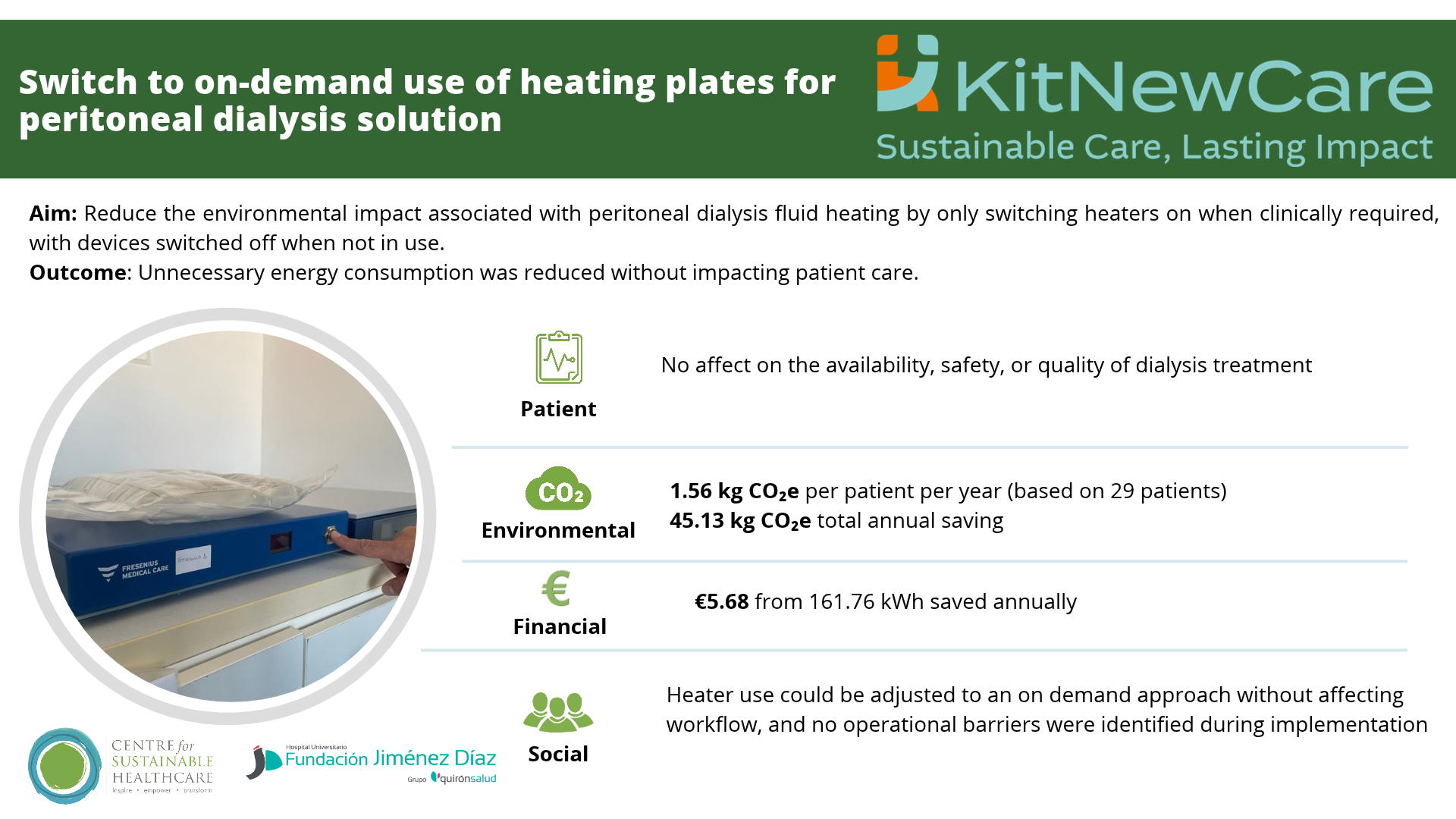
Heater use was limited to periods when fluid heating was clinically required, with devices switched off when not in use. Staff were informed that from now on the heaters should only be switched on when needed, instead of all the time.
This adjustment allowed the department to maintain safe and flexible patient care while avoiding unnecessary continuous energy consumption.
Outcomes
Patient Outcomes
The change in heater operation did not affect the availability, safety, or quality of dialysis treatment, and patient care procedures remained unchanged throughout implementation.
Environmental
Based on electricity consumption measurements collected over a one‑month period using a plug‑in energy meter, the estimated annual environmental saving was 45.13 kg CO₂e, corresponding to approximately 1.56 kg CO₂e per patient per year (based on 29 patients).
The estimated annual water deprivation saving was 19.31 m³, equivalent to approximately 0.67 m³ per patient per year.
Economic
Based on electricity consumption measurements collected over the one month observation period, the estimated annual electricity saving was 161.76 kWh. Using an electricity cost of €0.035137 per kWh, this equates to an estimated annual cost saving of approximately €5.68, or around €1.42 per heater across the four units
Social
The intervention was implemented without disruption to routine clinical practice. Heater use could be adjusted to an on demand approach without affecting workflow, and no operational barriers were identified during implementation.
Summary
Switching from continuous to on demand use of peritoneal dialysis heaters reduced unnecessary energy consumption without impacting patient care.
There is potential to apply similar approaches to other equipment within the organisation and other healthcare settings where continuous operation is not essential. Scaling this approach across departments and centres could contribute to cumulative reductions in energy use and associated emissions. In countries with a more carbon intensive energy grid the savings would be more substantial.
 Download resource -
Please log in or sign up to comment.