
This project was undertaken at Warszawski Uniwersytet Medyczny Hospital as part of the KitNewCare project.
Team members
Zuzanna Jakubowska1
Małgorzata Kępska Dzilińska1
Ewa Wojtaszek1
Jolanta Małyszko1
Paweł Żebrowski1
Urszula Jabłońska2
Jarosław Gopek3
1 physician, nephrologist
2 nurse
3 administrative worker / finance professional
Life Cycle Assessment Support
Life Cycle Assessments were conducted by Dr James Larkin, Postdoctoral Researcher and Sustainability Officer at Trinity College Dublin.
Setting/ patient group
The centre provides dialysis treatment to approximately 90 patients and employs a team of 5 doctors and 12 nurses. Before the intervention, each patient generated an average of 100 printed pages per year.
Additionally, the project extends to the Nephrology Department, which operates with an estimated 1,000 patient-days per month. Each of these patient-days requires multiple medical orders, making a streamlined, paperless process essential for improving efficiency and reducing administrative workload.
Issue
The haemodialysis department relied heavily on paper-based lab result printing and medical orders, leading to excessive paper waste, increased costs, and inefficiencies in doctor-patient interactions
Intervention
The project supported the transition to a paperless workflow within the nephrology and haemodialysis departments. Key activities included upgrading digital infrastructure, introducing electronic access to laboratory results and medical orders, and providing staff training and technical support. Progress was monitored through staff and patient feedback, alongside measures of paper use and workflow efficiency. A second phase explored the introduction of electronic signatures to further reduce paper-based documentation and streamline clinical processes.
Outcomes
Patient
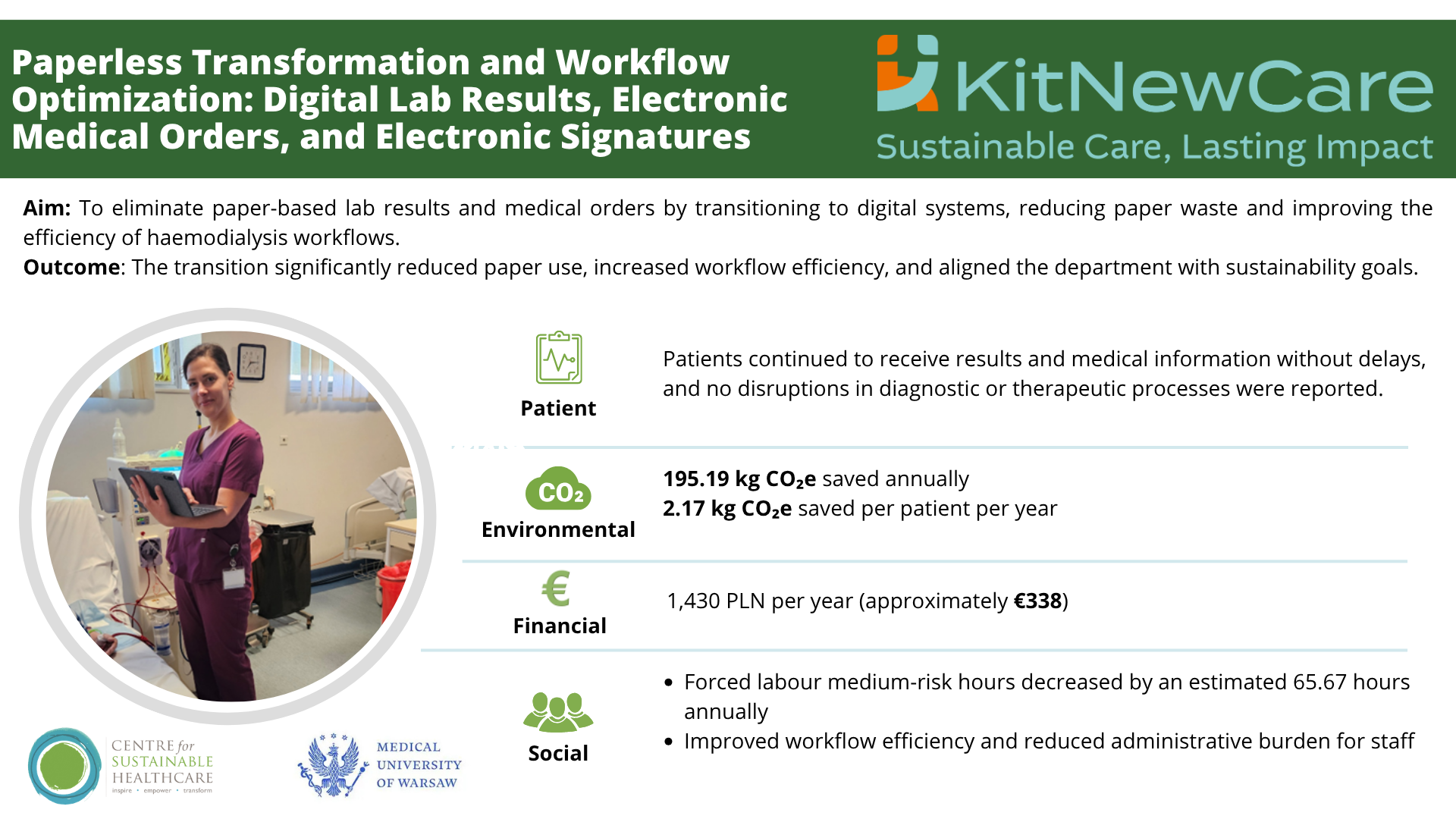
No negative clinical or organisational effects were observed following the transition to electronic documentation. Patients continued to receive results and medical information without delays, and no disruptions in diagnostic or therapeutic processes were reported.
Environmental
The move to a predominantly digital workflow reduced paper use by approximately 13,000 pages per year and eliminated the need for around two toner cartridges annually. This was associated with an estimated reduction of 195.19 kg CO₂e and 128.83 m³ water use impact per year, equivalent to approximately 2.17 kg CO₂e and 1.43 m³ water savings per haemodialysis patient annually.
Economic
The intervention generated direct savings of approximately 1,430 PLN (€338) per year through reduced paper and toner use. The greatest benefit came from improved efficiency, with the equivalent of 12 working days per year of specialist or resident time freed up through the elimination of paper-based processes.
Social
The estimated social impact, measured as forced labour medium-risk hours, decreased by approximately 65.67 hours annually. Staff also reported improved workflow efficiency, easier access to information, and reduced administrative burden associated with printing and paper-based documentation.
Summary
The transition to digital lab results, electronic medical orders, and partial adoption of electronic signatures significantly reduced paper use, increased workflow efficiency, and aligned the department with sustainability goals. These outcomes directly addressed the project’s aims of reducing waste, improving staff efficiency, and modernising documentation processes.
Key elements contributing to success included:
strong leadership support and clear policy direction,
adequate digital infrastructure (Wi-Fi, tablets, secure EHR access),
staff willingness to adopt new workflows, integration of changes directly into everyday clinical routines.
 Download resource -
Please log in or sign up to comment.