
This project was undertaken at Università degli Studi di Modena e Reggio Emilia (UNIMORE) Hospital as part of the KitNewCare project.
Team members
Gaetano Alfano: Nephrologist
Niccolò Morisi: Nephrologist
Giuseppe Di Chiaro: Nephrologist and PhD Student
Gabriele Donati: Head of Nephrology Department
Annarita Villani: Head of Dialysis Nurses
Rita Pecoraro: Dialysis Nurse
Giulia Ligabue: Biologist
Marco Ferrarini: Biotechnician
Silvia Giovanella: Biotechnician
Life Cycle Assessment Support
Life Cycle Assessments were conducted by Dr James Larkin, Postdoctoral Researcher and Sustainability Officer at Trinity College Dublin.
Setting/ patient group
This project took place in the Nephrology, Dialysis and Renal Transplant Department at a large tertiary centre managing a complex patient population across chronic and acute dialysis pathways. The centre provides approximately 40,000 haemodialysis treatments per year.
Issue
Despite an existing waste segregation system in UNIMORE, a significant portion of general or recyclable waste was still discarded as hazardous, particularly during busy dialysis workflows where convenience or uncertainty overrides correct disposal practices.
Intervention
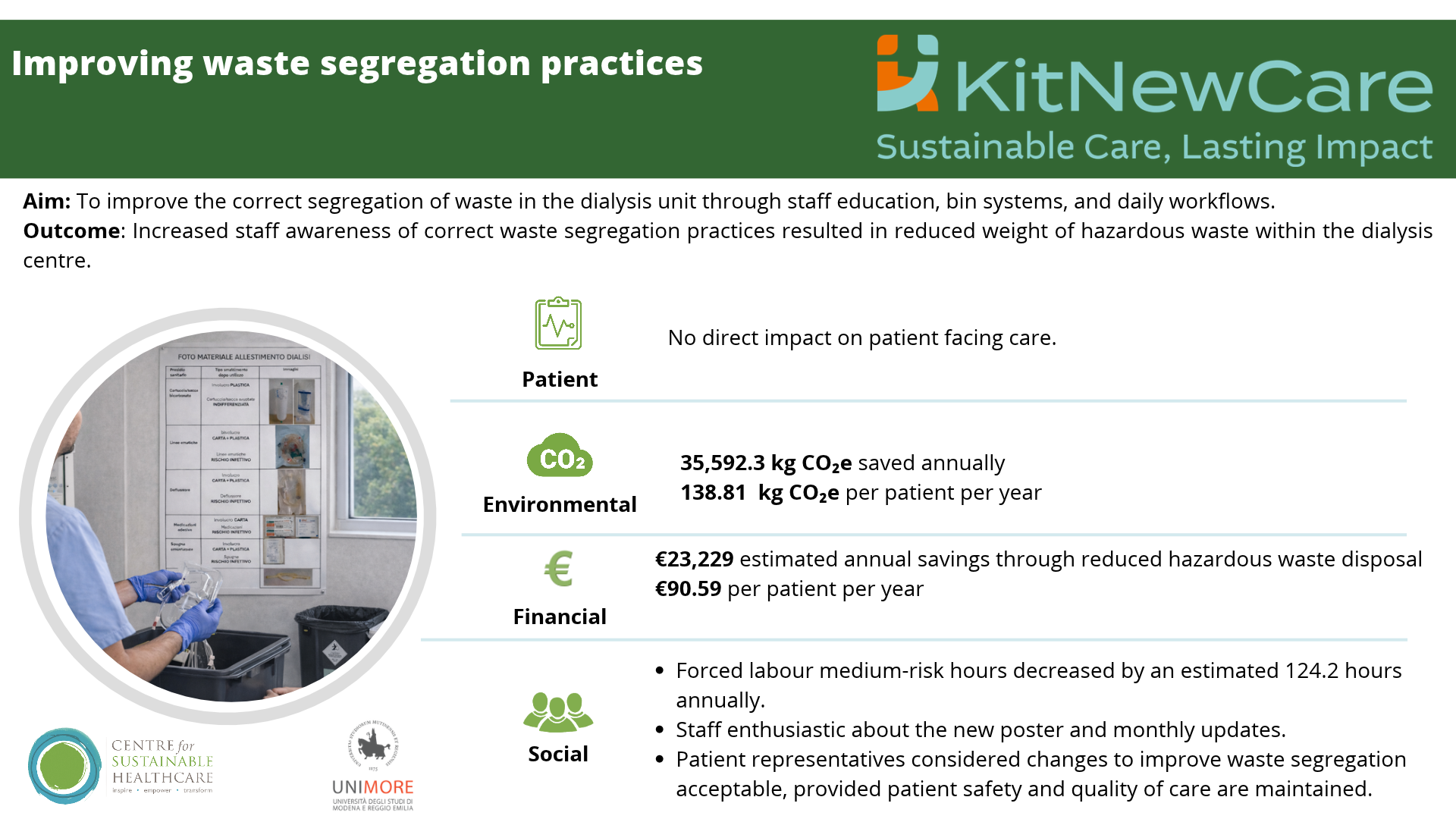
A multidisciplinary team including nephrologists, nursing staff, biologists, and technical personnel worked together to optimise waste segregation practices within the dialysis centre. Baseline observations and staff questionnaires identified variation in waste segregation practices and opportunities to improve understanding of hazardous and non-hazardous waste streams. A waste mapping exercise informed the development of a waste classification guide, supported by visual reminders displayed throughout the unit. Staff participated in educational sessions and practical workshops focused on waste segregation and recycling, with ongoing monitoring and feedback used to reinforce learning and track progress over time. Further details are provided in the accompanying PDF.
Outcomes
Environmental
Optimisation of waste segregation reduced hazardous waste by approximately 0.34 kg per haemodialysis treatment. This was associated with a reduction of 0.89 kg CO₂e per treatment, equivalent to 138.81 kg CO₂e per patient per year (based on three treatments per week) and 35,592.3 kg CO₂e annually across the service (approximately 40,000 treatments per year).
Water use impact also decreased by approximately 0.060 m³ world-equivalent per treatment, corresponding to 9.31 m³ per patient per year and 2,388.3 m³ annually at service level.
Economic
Based on local waste disposal costs, the reduction in hazardous waste is estimated to generate annual savings of approximately €23,229.
Social
The estimated social impact, measured as forced labour medium-risk hours, decreased by 0.0031 hours per treatment, equivalent to 0.48 hours per patient per year and 124.2 hours annually across the service.
Patient focus group findings indicated that measures to improve waste segregation were generally perceived as low risk and acceptable to patients.
Approximately 20 staff attended educational sessions. Feedback suggested that staff were previously unaware of some recycling opportunities but welcomed the guidance provided, while posters and monthly waste charts helped reinforce correct waste segregation practices.
Summary
The change project successfully reduced hazardous waste volume from the dialysis centre through improved waste segregation practices supported by staff education, visual aids, and feedback mechanisms. This resulted in consistent reductions across environmental and social indicators, including carbon emissions, water use, and estimated forced labour risk hours.
 Download resource -
Please log in or sign up to comment.