
This project was undertaken at Hospital Universitario Fundación Jiménez Díaz as part of the KitNewCare project.
Team members
Alberto Ortiz Arduan: Head of the Nephrology Service
Marina González de Rivera Utrera: Nephrologist
Alejandro Avello Escribano: Nephrologist
Lucía García Cordero Galán: Nephrologist
Rodrigo Martínez Cadenas: Bioinformatician and PhD candidate
Blanca Tarragón Estébanez: Consultant Nephrologist and Researcher
Mónica Pereira: Nursing Supervisor
Setting/ patient group
The intervention was implemented within the Nephrology unit of a university hospital participating in the KitNewCare project. The unit relies on multiple computers to support clinical care, including use during dialysis sessions, routine clinical activity, and on-call services.
Issue
Computers used for clinical and administrative work were routinely left on for extended periods, including outside of working hours.
Intervention
Devices not required for continuous operation were automatically powered down outside of working hours, while maintaining the ability to be switched on at any time if needed. 16 computers in the department were identified as appropriate for automatic shutdown.
Staff were trained prior to implementation to ensure awareness of the new system and its implications for workflow.
Outcomes
Environmental
For most devices, operation was reduced from continuous use (24 hours per day) to approximately 8 hours per day, with slight variation depending on function (e.g. 9 hours for administrative computers and 10 hours for specific clinical systems).
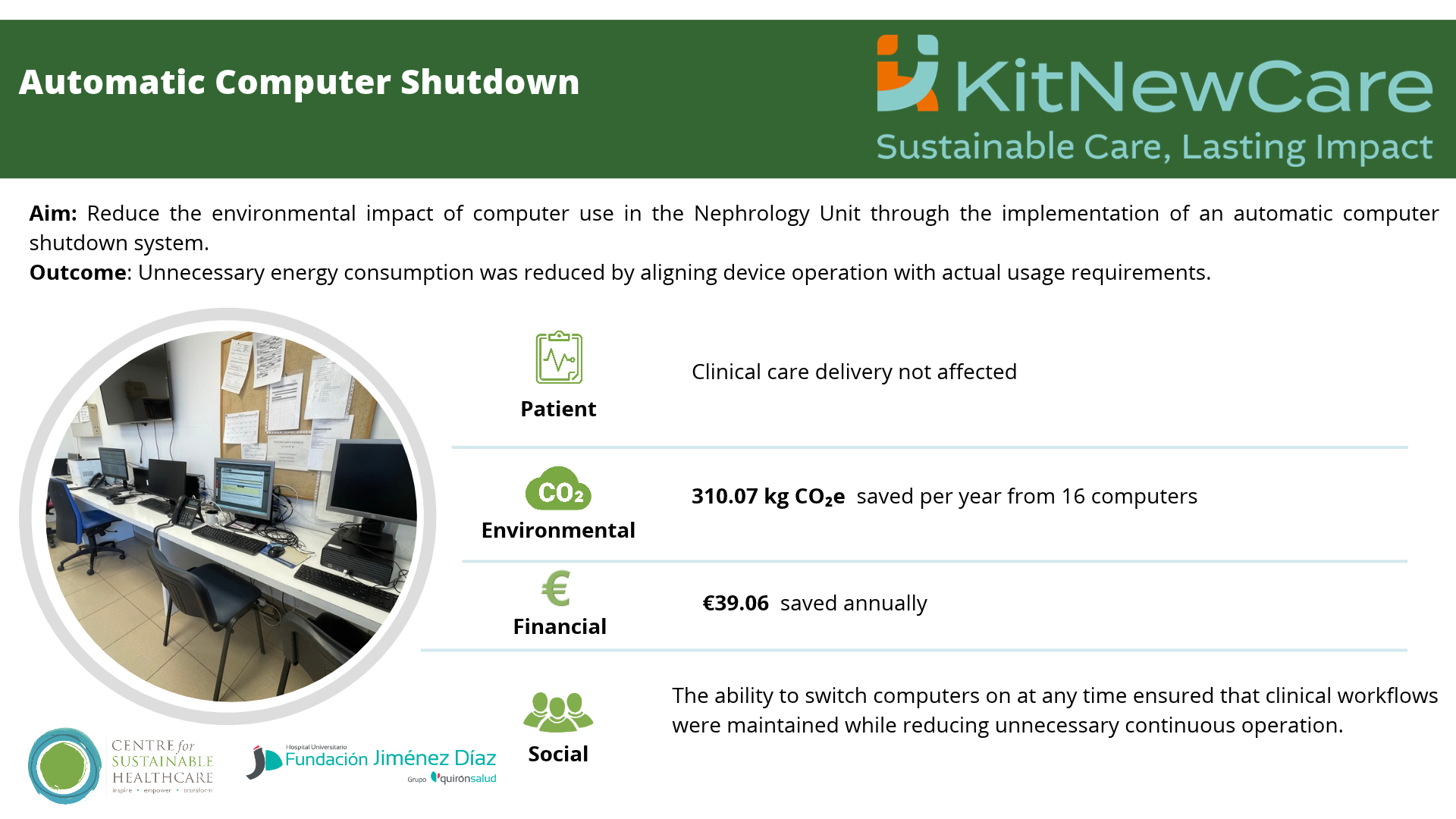
This resulted in estimated annual energy savings of 1,111.36 kWh, corresponding to a reduction of 310.07 kg CO₂e per year. Associated water deprivation savings were 132.70 m3. The annual savings per computer are 19.38 kg CO₂e.
Economic
The reduction in energy consumption resulted in a corresponding decrease in energy-related costs. Based on an electricity cost of €0.035137 per kWh, this equates to an estimated annual saving of approximately €39.06 per year, €2.44 per computer.
Social
The intervention was implemented within routine clinical practice without affecting access to computer systems required for patient care.
The ability to switch computers on at any time ensured that clinical workflows were maintained while reducing unnecessary continuous operation.
Summary
The implementation of an automatic shutdown system for computers in the Nephrology unit reduced unnecessary energy consumption by aligning device operation with actual usage requirements. The classification of computers according to operational need was important in ensuring that energy savings were achieved without compromising clinical functionality.
The intervention is now being scaled across other departments within the organisation.
 Download resource -
Please log in or sign up to comment.