
Project completed as part of the 2026 Green Gastroenterology Challenge
Team members
Sophie Young, IBD Clinical Nurse Specialist, Clinical Endoscopist
Jamie Catlow, Consultant Gastroenterologist.
Setting / patent group:
Newcastle Hospitals NHS Foundation Trust. provides care for patients with inflammatory bowel disease (IBD) receiving vedolizumab treatment. In May 2026, 181 patients were receiving intravenous (IV) vedolizumab and 231 were receiving subcutaneous (SC) vedolizumab.
Issue:
Vedolizumab can be delivered either through hospital-based intravenous infusions or home-administered subcutaneous injections. The Trust cares for patients across a large geographical area, with many travelling substantial distances for treatment. Patient transport is estimated to contribute significantly to the carbon footprint of IBD care. Local understanding was limited regarding patient experiences, treatment preferences, travel behaviours and the influence of environmental sustainability on decision-making. The project aimed to support NHS sustainability objectives while maintaining high-quality patient-centred care.
Intervention:
Eligible patients established on IV Vedolizumab were offered the opportunity to switch to SC Vedolizumab. Discussions were undertaken by pharmacists, the IBD team and MDT members during routine care. Patients received information about both administration routes and were supported to make informed decisions. New patients commencing Vedolizumab were switched to SC administration following completion of IV loading doses where appropriate and agreed by the patient. No additional staff training was required because SC Vedolizumab was already established within the service.
Outcomes:
Clinical:
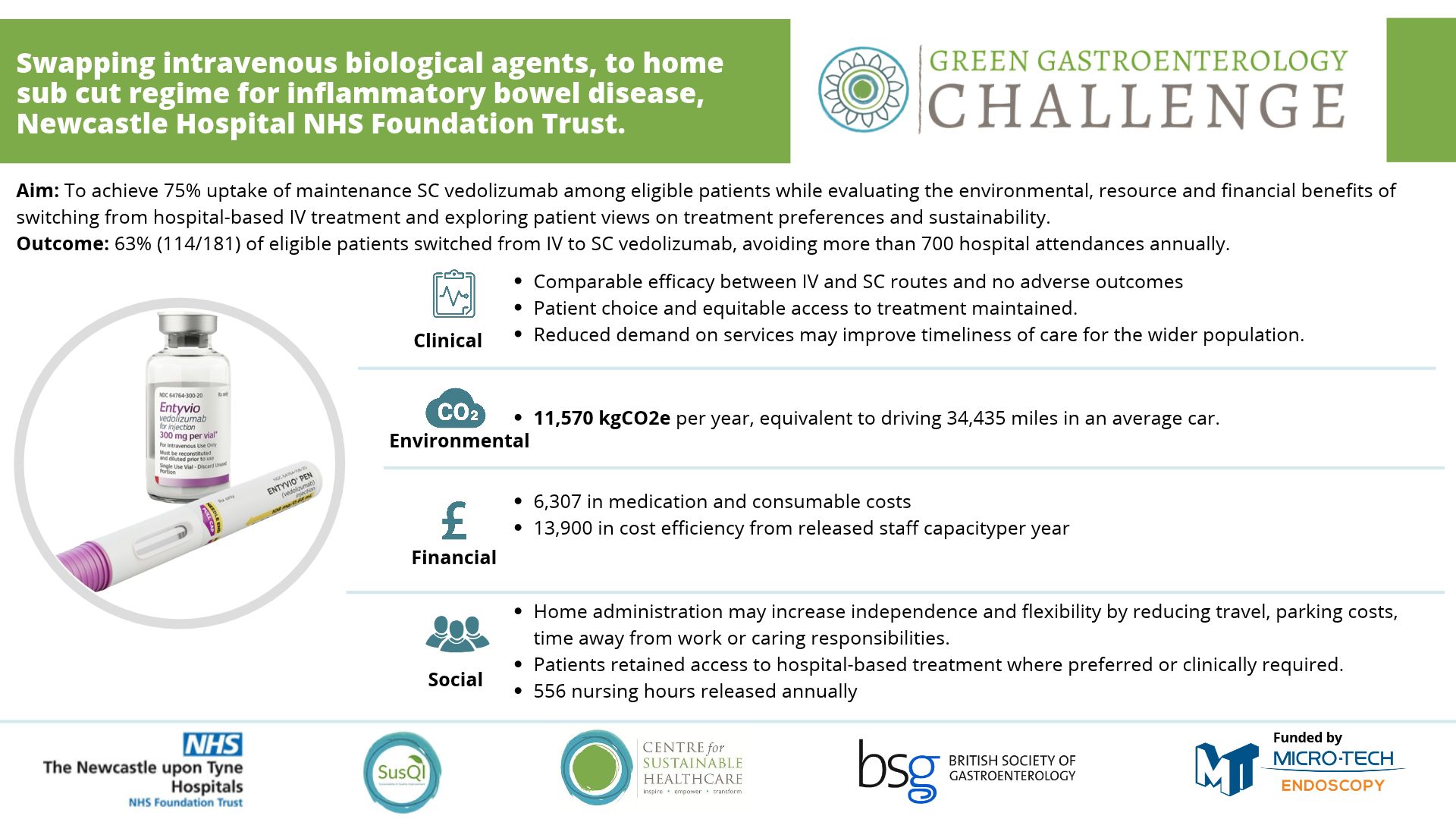
National guidance and the existing evidence base indicate similar efficacy between IV and SC Vedolizumab. No clinical issues related to switching from IV to SC Vedolizumab were identified during the project. Patients unsuitable for SC treatment, or those preferring IV treatment, retained access to hospital-based infusions. The project primarily identified benefits in patient experience, reduced hospital attendance and service capacity rather than changes in clinical outcomes.
Environmental:
The carbon footprint of a single IV vedolizumab attendance was estimated at 15.35 kgCO₂e, with patient travel contributing the largest share of emissions. Annual emissions were estimated at 19,371 kgCO₂e for the IV cohort, compared with 1,083 kgCO₂e for SC treatment. Of patients approached, 63% chose to switch to SC vedolizumab. Applying this uptake rate to the baseline cohort suggests approximately 114 patients could transition, reducing annual emissions by an estimated 11,570 kgCO₂e and avoiding around 742 infusion attendances annually. Environmental benefits were driven by reduced travel, consumable use, waste generation and healthcare resource utilisation.
Financial:
The annual treatment cost was £7,894.32 per IV patient compared with £7,839 for SC treatment, a saving of £55.32 per patient per year. If 114 patients transitioned to SC treatment, this would generate an estimated £6,306.50 annual saving. This would release approximately 556 nursing hours, equivalent to 70 eight-hour shifts, creating a further £13,900 in annual capacity savings.
Social:
Patient surveys showed a very positive experience of hospital-based infusion care. The most important factors influencing treatment decisions were feeling safe and monitored, comfort, and contact with healthcare professionals, while environmental impact ranked eighth out of ten priorities. Although SC treatment offers greater independence and reduces travel and appointment-related costs, many patients valued the reassurance of hospital-based care. The release of nursing capacity also created opportunities to support other patient care activities.
Key learning points:
The project demonstrated that wider adoption of SC Vedolizumab is clinically feasible and can deliver operational, environmental and economic benefits. However, patient preferences and clinical considerations remain the primary drivers of treatment decisions. The findings suggest that increasing uptake of SC Vedolizumab has the potential to reduce environmental impact, release
valuable clinical capacity and deliver modest cost savings, while maintaining patient choice and access to appropriate care.
 Download resource -
This is very interesting.
Please log in or sign up to comment.